
Blockchain
When discussing virtual currency, it is essential to ask the question of what blockchain technology is in simple terms and what cryptocurrency is in general.
Blockchain is a unique method of recording and storing digital data in such a way that it cannot be hacked, altered, or deleted without detection. This technology represents a chain of blocks where all information is stored. Each block flows into another, so if one link is deleted or altered, the entire chain collapses.
Blockchain can be programmed to record not only financial transactions but anything of value. This includes vehicles, real estate, various contracts, and more.
The Advantages of Blockchain Technology
- Transparency: each user can track all transactions made in the system.
- Decentralization: there is no central server for storing information. Data is distributed among all users of the system.
- Confidentiality: all data is encrypted. Users can track transactions but cannot identify the sender or recipient without an identification number. A private key is required to perform transactions.
- Consensus: Information added to the system is verified by other users through reading hashes — recalculating specific values using complex formulas.
- Security: Existing data cannot be changed or new data added without authorization. Any attempts to do so will automatically be rejected by the system. Altered records won’t match existing copies and require a unique key issued by the system.
We will discuss everything about blockchain and cryptocurrency in more detail below.
The History of Blockchain Technology
The technology did not appear instantly; its development went through three stages.
Stage 1: Security of Digital Documents
In 1991, researchers S. Haber and W. Scott Stornetta developed a system similar to blockchain. They introduced an innovative computational solution for storing digital documents with timestamping. The main purpose was to protect documents from deletion, modification, or forgery.
Stage 2: Satoshi Nakamoto and the Creation of Bitcoin
An unknown individual or group (still a mystery) named Satoshi Nakamoto published the “White Paper” in 2008, which detailed the concept of peer-to-peer (P2P) digital money technology.
Stage 3: Vitalik Buterin and Ethereum
Blockchain technology started being used not only for cryptocurrency but also for transferring assets across various sectors. However, creating a new blockchain from scratch for each project was inefficient.
Thus, in 2013, Vitalik Buterin developed the Ethereum platform, allowing for the creation of blockchain programs using smart contracts—virtual agreements executed by computer code within the platform.
Ethereum became the “cryptocurrency fuel” that organizations could use to implement blockchain into third-party applications.
What is Blockchain Technology in Simple Terms?
Let’s start with the distributed database. What is it?
A distributed database is like a table copied thousands of times across a computer network. The network is structured so that data can be regularly updated — this, in essence, is blockchain.
Thus, the blockchain database is not stored in one location. It records everything publicly and is easily verifiable.
The image below shows the basic principle of how blockchain works with cryptocurrencies.
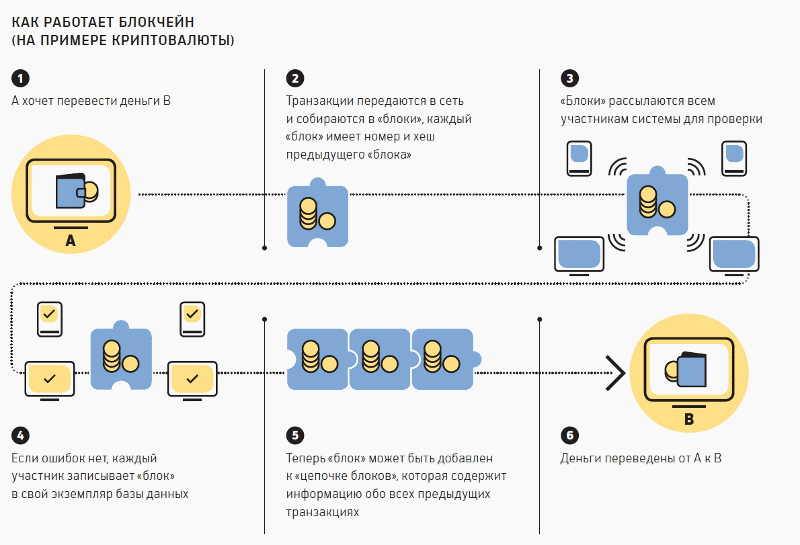
In simple terms, blockchain is like a filing cabinet where data cards are sequentially arranged one after another. To prevent unauthorized tampering or removal, all information is encrypted. Even if one card is lost or destroyed, under certain conditions, it can be restored if there is access to a special system key.
Therefore, to ensure better security, each card has multiple copies stored in various locations.
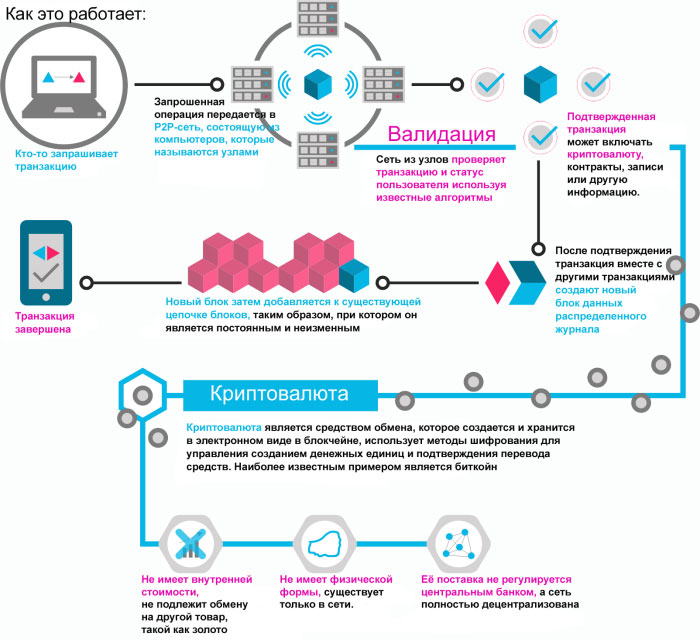
The image shows how blockchain connects to cryptocurrency.
Encryption guarantees that users can only modify blocks to which they have access. It also ensures the consistency of all distributed copies among participants.
Originally, blockchain aimed to provide reliable and secure data storage. The concept was described by Satoshi Nakamoto in 2008 and implemented in 2009 with the creation of Bitcoin, where blockchain serves as a public ledger for all transactions.
Blockchain allowed Bitcoin to become the first cryptocurrency that solved the “double-spending” problem without needing a central authority or server.
The reliability of blockchain is ensured by its decentralized time-stamped structure and peer-to-peer network architecture, creating an autonomous data management system.
The Difference Between Blockchain Technology and a Traditional Database
While blockchain is similar to a traditional database, it has distinctive features:
- Blockchain does not store data itself; it stores records of past transactions in chronological order.
- Before being added to the blockchain, information is verified for authenticity and cryptographically secured.
- Information is only recorded in the blockchain once the majority of participants approve it, ensuring decentralization and eliminating the need for a central authority.
- Data is organized not in tables (as in traditional databases) but in sequential blocks, each containing a link to the previous one.
- It is impossible to delete or alter information in the blockchain without a unique system access key.
Three Types of Blockchain Technology
- Public Blockchain
This type is openly accessible. Anyone can view the blocks, send data, and participate. Anonymity of users is preserved because public blockchains are fully decentralized. Data integrity is guaranteed through economic incentives and cryptographic verifications like proof of work or proof of stake.
However, public blockchains often face significant limitations in terms of transaction volume and processing speed. Most cryptocurrencies operate on public blockchains.
- Private Blockchain
In a private blockchain, only one user or a group of authorized users can write data. It is a closed, centralized system where issues can be manually corrected without proof of work or stake. Although access can be restricted, the system still maintains the decentralized nature of data storage.
To participate in a private blockchain, one must meet specific admission criteria.
- Consortium or Hybrid Blockchain
This type is used by multiple enterprises needing a shared platform for transactions or data exchange. The consensus process is controlled by a set of predetermined equal nodes. This blockchain type is partially decentralized and easier to manage than public blockchains but requires trust among participants.
Transactions in Blockchain Systems
Blockchain is a secure, public digital ledger that continuously records asset movements in either public or private networks. Every node in the network stores a copy of the entire history of transactions.
New confirmed blocks are added sequentially, creating a reliable record. Users can only view transactions related to their own addresses.
Instead of relying on intermediaries like credit institutions, blockchain uses consensus protocols, cryptographic hashing algorithms, and electronic signatures to validate transactions.
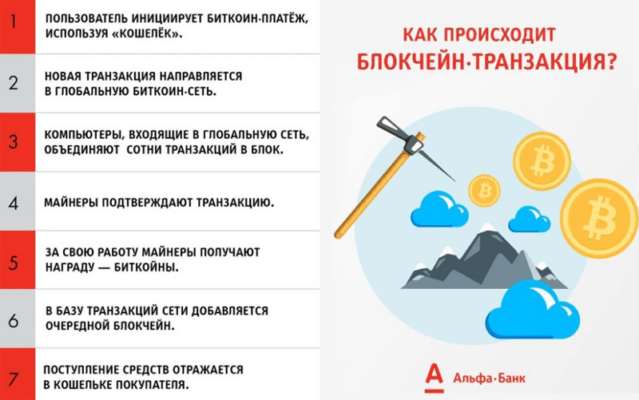
Consensus protocols ensure the accuracy of each copy of the distributed ledger. Cryptographic hashing (e.g., SHA-256) prevents unauthorized access and alteration. Electronic signatures confirm that transactions are executed by the rightful users with system-issued private keys.
The decentralized, peer-to-peer nature of blockchain prevents any one participant from controlling or disabling the network.
Transaction Confirmation
Until a transaction is recorded in the blockchain, the system considers that the number of BTC (bitcoins) has not changed. During this period, it is technically possible to attempt to send the same BTC to different recipients.
Once one of these transactions is confirmed, all others are automatically rejected. If two similar transactions are included in different blockchain branches, both may initially appear valid. However, once one branch is discarded, the associated transaction is treated as invalid.
Thus, recording a transaction in a block is regarded as confirming its authenticity, regardless of competing transactions with similar parameters.
Double Spending
If an entity controls more than 55% of the network’s total computational power, they could theoretically send the same bitcoins to two different recipients. One transaction would be public and official, while the second would remain hidden within a parallel chain.
Over time, the hidden chain could overtake the public chain, making the hidden transaction valid and invalidating the public one. This would result in the first recipient losing bitcoins without any reimbursement.
However, throughout the entire existence of Bitcoin, no successful “double spending” attacks have ever been recorded.
Difficulty
The difficulty parameter regulates the requirements for block hashes in the blockchain. Since the network’s computational power fluctuates, difficulty is recalculated every 2016 blocks to maintain an average block generation rate of one block every 10 minutes.
In practice, when computational power increases, block times shorten; when power decreases, block times lengthen. The system can adjust difficulty by analyzing timestamps and block creation times.
Advantages and Disadvantages
Like any developing technology, blockchain has both strengths and weaknesses. One of the main risks is the so-called “51% attack,” where malicious actors gain control of more than half of the network’s power, potentially compromising its integrity.
Advantages:
- No central authority controlling the system.
- Transparency and public accessibility.
- Immutable and tamper-proof records.
- Equal participation rights for all users.
- No need for intermediaries.
- High transaction processing speed.
- Encrypted information ensures security.
- Wide applicability across various industries.
Disadvantages:
- High cost of implementation.
- Significant energy consumption.
- Lack of comprehensive legal regulation.
- Risk of fraudulent activities.
- Limited scalability for large-scale applications.
The Future of Blockchain Technology
Blockchain technology is still in its early stages but already shows enormous potential across different sectors. Developers are actively working on addressing existing flaws and improving the system. Many companies are considering adopting blockchain for their operations.
Forecasts suggest that by 2024, the global blockchain market could grow to $62 billion, with financial services making up the majority of this value.
Potential changes with blockchain adoption include:
- Digital IDs: Companies like Microsoft are exploring decentralized digital identification systems, offering each person a unique digital identity number.
- Global financial transformations: Blockchain could help banks cut costs by up to 53%, though it may also disrupt traditional financial institutions.
- Healthcare innovations: Private blockchains could securely store medical records, prescriptions, and patient information, reducing fraud and improving healthcare efficiency.
List of Popular Cryptocurrencies Based on Blockchain Technology
- Ethereum
Ethereum is based on the use of smart contracts. Thanks to their flexibility, this cryptocurrency became a popular platform for creating new blockchain applications. Developers no longer need to build their own blockchain from scratch — they can simply define parameters within the existing system.
- Aragon
This project implements the concept of decentralized organizations within the blockchain — eliminating the need for paper documentation and using only digital records. Initially, Aragon is targeting small businesses, but the long-term goal is global expansion and integrating conflict resolution systems that connect smart contracts to real-world business processes. Thus, Aragon represents a foundation for decentralized economies.
- NEM
NEM’s main distinction from Ethereum is its higher transaction speed. NEM provides a platform capable of handling millions of transactions, and developers are continually working to enhance network throughput and lower transaction fees.
- Ripple
Ripple is a major competitor to NEM. It aims to reduce transaction fees and processing times. Several major financial institutions are already testing Ripple’s system. However, the main drawback is the somewhat non-transparent distribution of assets.
- Siacoin
Siacoin is a project for decentralized cloud storage. Key features include:
- an advanced system for distributing encrypted data across multiple independent computers,
- low subscription costs,
- encrypted data that cannot be disclosed at the request of government authorities.
- Dash
Dash focuses on enhanced privacy features. It ensures transaction confidentiality at the protocol level, maintaining user anonymity. Additionally, Dash incorporates instant transaction confirmations and a unique governance model.
- Bitshares
Bitshares tokens serve as proof of ownership for various assets. This project operates as a decentralized exchange for trading asset ownership, with the option to peg the value of assets to other units like currencies or precious metals.
Conclusion
So, what is blockchain technology in simple terms, and what is cryptocurrency?
While the adoption of cryptocurrencies and blockchain technologies is still in its early stages, it’s impossible to predict which systems will succeed long-term. However, blockchain’s potential is often underestimated simply because new technologies tend to provoke fear and resistance. Understanding the core principles, strengths, weaknesses, and real-world potential of decentralized systems is crucial for evaluating their financial and practical impact.
Read more articles in the blockchain section.