
Ada cryptocurrency — a Japanese analog of Ethereum, created in 2015.
Cardano is a decentralized network based on blockchain with open-source code. Its creators use modern scientific approaches, develop cutting-edge technologies, and enrich the project with functional capabilities. Moreover, it is the first blockchain platform whose concept emerged from scientific philosophy and whose development benefited from a research-oriented approach.
Ada is the main cryptocurrency of the Cardano project. However, in the world of virtual currencies, this digital asset is referred to both as Ada and Cardano.
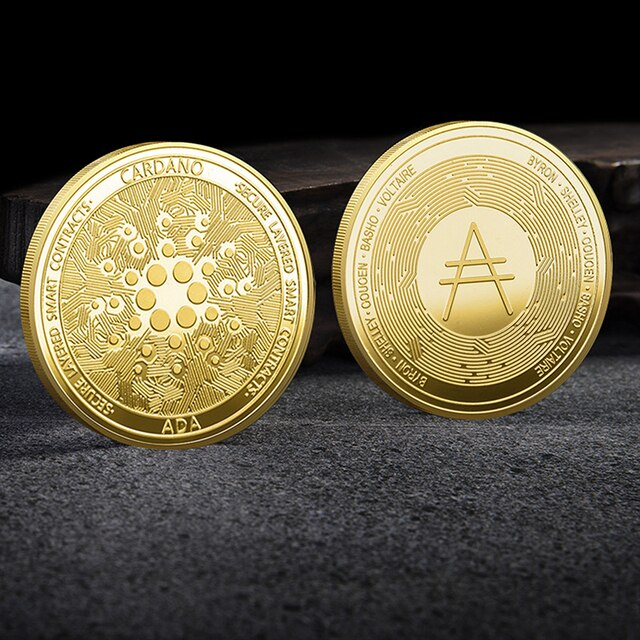
Ada Cardano Cryptocurrency and Its History
Ada crypto has its own background. In 2014, Charles Hoskinson left the Ethereum project and, together with Jeremy Wood, created a new project — Cardano. During this period, three companies were founded:
- Input Output Hong Kong (IOHK) — one of the leading organizations in blockchain research and development.
- Emurgo — an investment fund with offices in Asia and the USA. Emurgo invests in crypto startups and helps clients integrate into the Cardano ecosystem.
- Cardano Foundation (CF) — an independent private company that owns the Cardano brand. It oversees, organizes the protocol’s development, and communicates with global regulatory authorities.
The Ada Cardano cryptocurrency itself appeared in 2015. Most coins were initially located in Asia, where there were no strict blockchain regulations. Ada could first be purchased on crypto exchanges in 2017. Ada crypto successfully survived the “crypto winter” and bear market, during which developers worked on new technologies.
In 2020, it began operating on the Proof-of-Stake (PoS) crypto algorithm, and by 2021, smart contracts gained functionality.
The key distinguishing feature of the Cardano project is a strict scientific approach to development: all innovations undergo peer review by scientific researchers, ensuring Cardano blockchain’s stability and security while allowing early detection of system weaknesses.
Currently, Ada cryptocurrency and its project have the largest blockchain operating on an eco-friendly PoS consensus algorithm. This method reduces staking costs by 99% compared to mining. However, once Ethereum fully transitions to the same algorithm, this title will be lost.
The project was initially funded through an ICO conducted in four phases between 2015 and 2017. The selling price was approximately $0.02 per coin, raising over $60 million. The primary target market was Japan, and the official website supported two languages — Japanese and English.
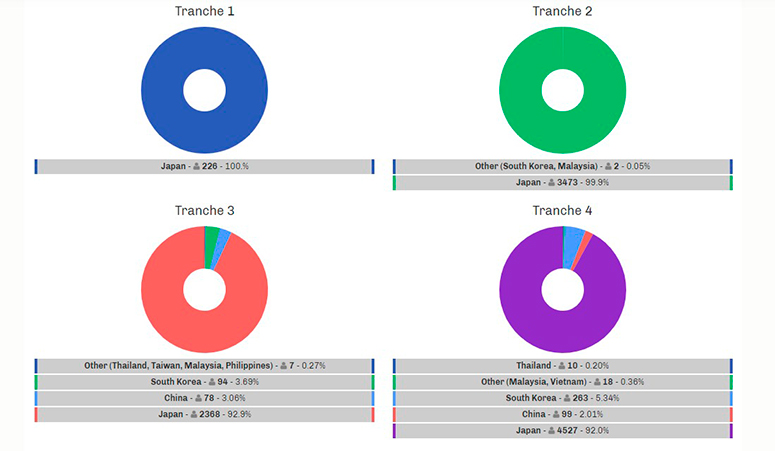
Additionally, over 25 million Cardano coins were distributed among traders, while over 5 billion Ada coins were allocated for project development and promotion. IOHK received over 2.35 billion tokens, Emurgo — around 2 billion, and the Cardano Foundation — about 650 million coins.
The total Ada cryptocurrency emission is 45 billion tokens. As of early 2023, about 76% of coins (34 billion) were in circulation, with the rest gradually released through monetary expansion. Cardano crypto appeared on exchanges in autumn 2017, growing from $0.026 to $1 within three months.
Ada Cardano cryptocurrency follows a detailed development roadmap planned up to 2025, which includes the following stages:
- Byron — development of the blockchain and core ecosystem components, formation and growth of the community.
- Shelley — decentralization phase through Ada staking introduction.
- Goguen — expansion of functionality with smart contracts, DApps, and various tokens, including NFTs.
- Basho — network scalability upgrades, including SideChains for reducing load and enabling reliable update testing.
- Voltaire — introduction of a democratic voting system, allowing users to support community projects and influence the blockchain’s future.
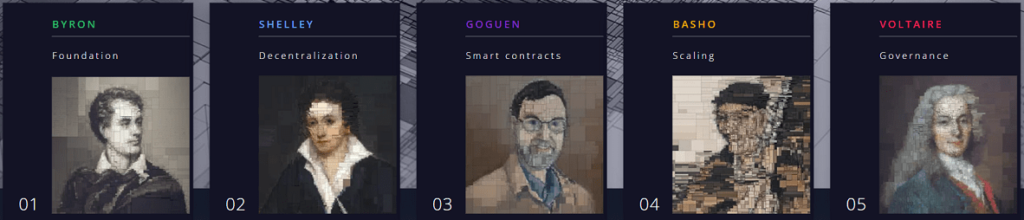
Cardano’s final goal is quite ambitious — to develop a fully decentralized and self-sustaining system.
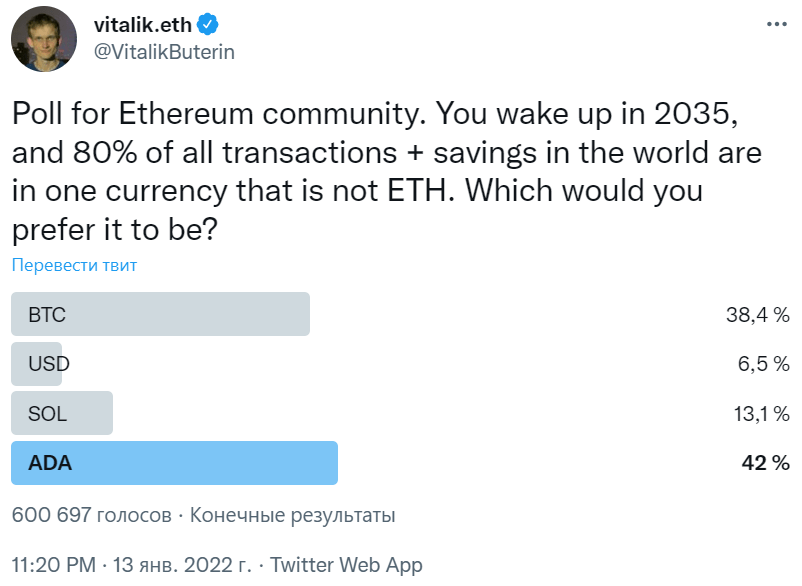
By 2023, the project is in the Goguen phase — smart contracts are operational, and work is underway to support decentralized applications. Work on Basho scalability upgrades has also begun. Despite many unachieved tasks, the ETH community already views Ada as Ethereum’s main competitor, evidenced by Vitalik Buterin’s Twitter poll:
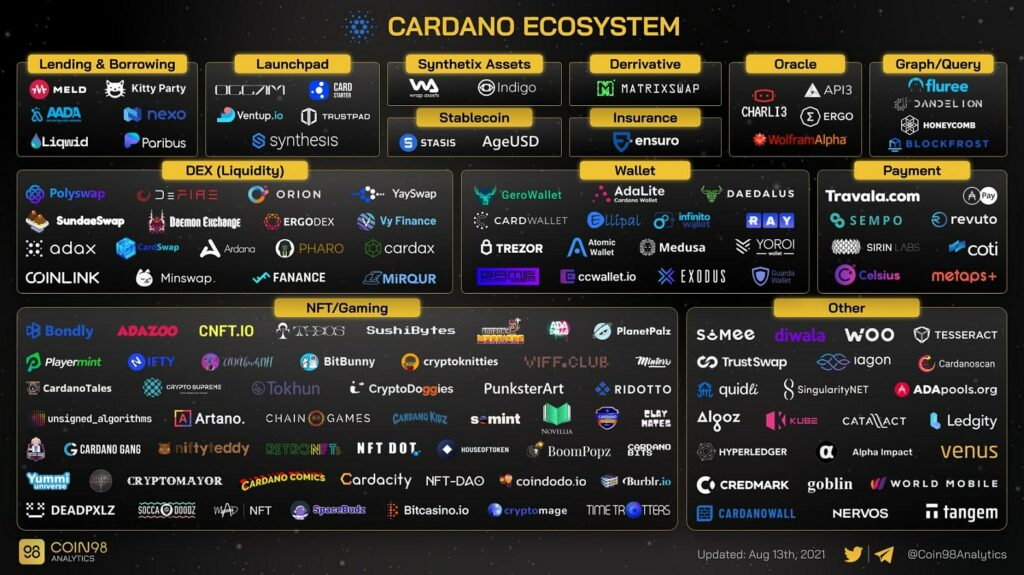
Nothing surprising here, as the Cardano ecosystem and its Ada cryptocurrency are rapidly evolving. It already includes about 10 projects across various crypto sectors, with numbers growing annually:
Cardano Cryptocurrency and Its Key Features
Ada is the native token of the Cardano blockchain. According to the creators, Ada is a virtual asset for fast and secure P2P transfers.
The Cardano platform aims to deploy smart contracts, develop DApps and DeFi, and foster new sidechains where tokens can function outside the main network. It positions itself as a new-generation Ethereum.
What Makes Ada and Its Project Unique?
First, the introduction of a scientific approach.
The companies supporting Cardano fund academic blockchain research, financial technologies, and cryptography while collaborating with leading universities in Greece, the UK, and Japan. The Cardano project is not based on Bitcoin or Ethereum blockchains.
Second, strict adherence to the roadmap.
All innovations undergo prototyping: initial testing, then a rough draft, followed by the definition of expected functionalities in technical specifications, using mathematical methods for testing.
Third, use of the Haskell programming language, enabling the development of an advanced ecosystem with various smart contract tools.
Fourth, the Ouroboros protocol.
This protocol minimizes electricity consumption for transactions. It was developed by a large team of scientists from top global universities.
Fifth, multilayered blockchain architecture.
Cardano’s blockchain is uniquely divided into two layers:
Layer 1 — Cardano Settlement Layer — manages participant balances and the blockchain economy.
Layer 2 — Cardano Control Level — includes all smart contract functionalities and tools.
This multilayer structure ensures high network throughput and increases transaction privacy.
Cardano’s blockchain is considered third-generation.
Ada Cardano Cryptocurrency and How It Works
The project is based on the robust Ouroboros protocol and the Proof-of-Stake algorithm, which eliminates the need for complex computations. Network governance is decentralized among nodes that maintain network connectivity and create new blocks. To incentivize users, a reward system for honest participation was introduced.
Detailed Mechanism of Cardano’s Operation:
- In the Ouroboros protocol, transaction blocks are divided into epochs, and epochs into slots. Each slot has a defined stake distribution. One epoch contains 432,000 slots.
- To manage block formation, a slot leader is selected among node operators. Selection is based on the amount of stake and a random initial value generated by computations. The slot leader’s main task is to process incoming transactions and validate blocks.
To ensure protocol security, a mechanism called “delay in calculations” was introduced. Slot leaders do not immediately start their tasks; some structural parts must transition. Specifically:
- During transaction recording, the distribution of stakes affecting slot leader selection changes,
- Coin holders can delegate their staking rights to pools. Node users chosen by delegation can earn additional rewards, increasing their chances to become slot leaders. This motivates decentralized network security,
- Users delegating their coins receive a certificate recorded in the blockchain. Settings can be changed at any time, creating a new record. Ownership of coins remains solely with the holder and is not transferred during delegation.
Ada Cardano Cryptocurrency Features:
- Cardano coins were created on their own blockchain,
- After the 2021 spring update, users can create new cryptocurrencies on the Cardano blockchain, including NFTs,
- Ada crypto is considered environmentally friendly due to minimal energy consumption, making it a green alternative to BTC,
- The platform collaborates with African countries. An agreement was signed with Ethiopia’s Ministry of Education to issue about 5,000,000 blockchain-based student identity certificates. These certificates help verify identity when applying for jobs,
- Following the Hydra update, transaction processing speed increased significantly, making Ada crypto an excellent option for fast transfers.
Mining Ada Cardano Cryptocurrency
The network operates on the PoS crypto algorithm, thus it is impossible to mine Ada using graphics cards or specialized devices. Currently, Ada coins can be earned as follows:
Coin holders can earn rewards in two ways: by delegating their stake to a pool operated by someone else or by managing their own stake pool.
The size of the stake delegated to a pool determines the Ouroboros protocol’s choice of who adds the next block to the blockchain.
The larger the stake a participant delegates over time, the higher their chances of creating a new block. Rewards are then distributed among all those who delegated to that pool.
Delegation allows Ada holders to participate in the network and earn rewards proportionally to their delegated stake.
Transaction Processing Speed
The first network testing occurred in 2017, when the transaction speed was about 255 TPS, surpassing BTC and ETH. But after implementing Hydra in 2020, a real breakthrough happened.
Hydra is a protocol that moves transaction processing off-chain. This allows parallel transaction processing, immediate confirmation, and improved network scalability. Off-chain channels can handle up to 1,000 transactions per second.
If a thousand pools use this protocol, throughput could reach one million transactions per second.
Advantages and Disadvantages of Cardano Cryptocurrency
Like any other virtual currency, Ada crypto has its strengths and weaknesses. Let’s look at them in detail.
Advantages of Ada:
- Developer team: Over a hundred experts, including mathematicians and cryptographers, work on blockchain development,
- Scientific approach: All innovations are peer-reviewed by the research community,
- Strict adherence to the development roadmap up to 2025,
- Minimal transaction fees: currently 10 times lower than Ethereum,
- Support for smart contracts, crucial for blockchain market capitalization growth,
- Democratic style in mining and transaction operations: New Cardano coins are mined based on collective staking power, and transactions depend on the number of payments,
- Continuous innovation aimed at user and data security,
- Use of the PoS crypto algorithm: only nearby validators can confirm a new block,
- Ability to make future changes and improvements without significant blockchain protocol alterations, thanks to chain splitting capabilities,
- Use of the Haskell programming language, considered one of the most stable programming languages,
- Large community: Ada has over 1 million followers on Twitter.
Disadvantages:
- Less widespread compared to BTC and ETH, with fewer purchase and sale options,
- High competition: Many promising projects compete for a place in the crypto industry,
- Slow development compared to crypto competitors,
- Governance mechanism still needs improvement.
Ada Crypto and Its Backing
Like most other virtual currencies, Cardano has no physical backing. This means it is not supported by fiat (such as dollars, euros, rubles), precious metals (gold, platinum), natural resources (oil, gas), securities, or any other assets. As a result, Cardano experiences high volatility. However, the developers are actively working to increase Cardano’s popularity by implementing modern technologies, thereby upgrading the platform and contributing to its growth in value.
Ada Cardano Cryptocurrency Price
As of early 2023, the price of Ada cryptocurrency is $0.38, with a market capitalization of over $13 billion.
The price of the cryptocurrency is influenced by:
- the general situation on the cryptocurrency market,
- the price of Bitcoin,
- the global political climate,
- the introduction of updates, including hard forks that enhance the protocol and scalability,
- the active social media presence of the creators,
- the creation of new assets, including NFTs on the blockchain,
- statements made by influential public figures.
The current price of Ada cryptocurrency in rubles and dollars can be checked here.
Ada (Cardano) Cryptocurrency Forecast
It is challenging to predict the future of Ada Cardano cryptocurrency, though some experts attempt to do so.
Expert projections for Ada based on analytical data:
- 2023 — minimum price: $0.46, average: $0.54, maximum: $0.57,
- 2024 — minimum price: $0.77, average: $0.86, maximum: $0.95,
- 2025 — minimum price: $1.16, average: $1.24, maximum: $1.34,
- 2026 — minimum price: $1.52, average: $1.61, maximum: $1.73.
Where to Buy Ada Cardano Cryptocurrency?
You can purchase Ada cryptocurrency through a cryptocurrency exchange, an exchanger, or a private transfer.
Cryptocurrency Exchanges
Cardano ranks among the top 10 cryptocurrencies by market capitalization. It is available on almost any major crypto exchange, making it the easiest and safest option.
Exchange Services
You can buy Ada via an exchanger by transferring funds through electronic wallets, cryptocurrency wallets, payment systems, or bank cards. Here, the site acts as an intermediary. Advantages include quick purchases and the ability to use standard currencies such as ₽, $, or €. Disadvantages include lower reliability, a limited range of assets, and high commissions.
Through Private Transfer
One user can transfer Ada to another’s crypto wallet or exchange account. All transaction details, price, and conditions are agreed individually. However, without a trusted intermediary, there is a high risk of fraud and loss of funds.
Prospects of Ada Cryptocurrency
The Cardano ecosystem is a thoughtfully developed technology aimed at creating a decentralized economy and democratizing financial resources, particularly in emerging markets.
The platform continues to evolve through various stages and updates. Investors have high expectations, anticipating significant price increases. Cardano’s flexible architecture facilitates improvements across various areas through soft forks.
Cardano is the first blockchain project developed based on scientific research. As full decentralization is achieved, the community will govern the network through innovative features.
Given its technical capabilities and innovations, the project has strong prospects for becoming increasingly essential and beneficial.
One key factor influencing a virtual asset’s popularity is scalability. Currently, Cardano’s processing speed limits its competitiveness against other major digital currencies. However, future updates are expected to increase this capability significantly.
Cardano has survived and grown during bearish markets, and today, it stands among the major players in the crypto industry.
Conclusion
The crypto industry has created fertile ground for innovative projects — one of them being Cardano and its Ada cryptocurrency. The project’s goal was to develop a blockchain that would outperform older networks in speed and efficiency. Cardano’s scientific approach and expert evaluations distinguish it from others.
The Cardano network is decentralized, meaning no government body controls it. All transactions and smart contracts are validated by the community through their computational power.
Read more in the cryptocurrency section.